Ground Truth. Know what your control system actually does.
Before anyone changes it.
AIn the sample: four severity A hazards. Releasing the E-stop restores the pump permissive without a reset. See the findings ↓
Site photos and a program backup become as-found drawings, a control narrative, a cause and effect matrix, a live model of the real logic, a ranked findings register and training for every role.
Real process and logic. Engineering by David Landry on an industrial project; model engine, verification and tools by Landry Industrial. Client details changed. Preliminary engineering review draft — not for construction.
RUNG 2:20 · PUMP A PERMISSIVE · AS FOUND0 COMMENTS IN THE PROGRAM
DECODED FROM THE BACKUPTAGS FROM THE RECONCILED I/O LIST
E-stop released · low level made · no reset pressed
A
The permissive comes back on its own.Releasing the E-stop restores the pump permissive without a reset. Starter wiring is an open question. Finding PLC-D02.
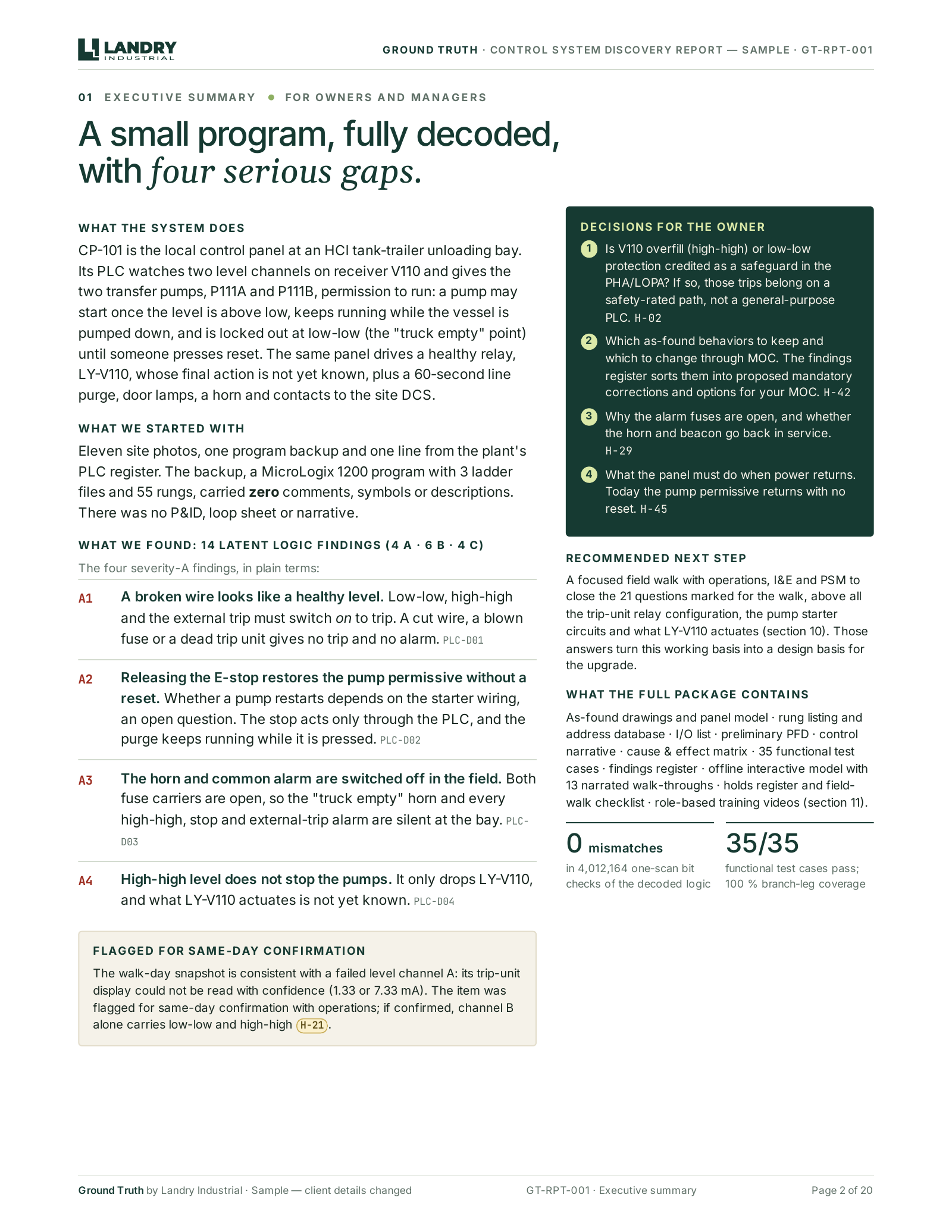
The sample program holds 14 latent findings: 4 severity A, 6 B and 4 C. Here are the four severity A findings, each with its recommended correction.
APLC-D01
A broken wire gives no trip.
What happens
The low-low, high-high and external trip inputs (LALL-A/B, LAHH-A/B, LY-X130) are energize-to-trip: the PLC trips only when a contact closes. Only the high-level pair is read fail-safe. A broken wire, a blown fuse or a lost supply looks exactly like a healthy process.
Recommended correction
Make the trips de-energize-to-trip with wire-break detection, and confirm the level-switch relay failure mode on site.
Rungs 2:3, 2:5, 2:11, 2:22
APLC-D02
Releasing the E-stop restores the pump permissive.
What happens
The emergency stop acts only through the general-purpose PLC and is not latched for the pumps. When the button is released, the pump permissive returns without a reset. Whether a pump then restarts depends on the starter wiring, an open question for the field walk.
Recommended correction
Hard-wire a two-channel E-stop through a safety relay, latch the pump trip so a restart needs a deliberate reset, and alarm on circuit discrepancy.
Rungs 2:5, 2:20–21 · test cases TC-18 to TC-20
APLC-D03
The alarms are silent in the field.
What happens
The logic drives the horn and the common alarm, but their fuse carriers are open in the panel. The “truck empty” horn and every high-high, stop and external-trip alarm make no sound.
Recommended correction
Restore the horn and common alarm under MOC, after reviewing horn behavior: silence, re-sound and reset.
Panel observation O-14 · rungs 3:2, 3:3
APLC-D04
High-high level does not stop the pumps.
What happens
On high-high level the logic drops the unit trip output and alarms. The transfer pumps keep their permissive. Overfill protection depends entirely on what that one output does downstream.
Recommended correction
Stop both pumps on high-high level. If overfill protection is credited in the PHA, it belongs in a suitable independent layer, not this general-purpose path.
Rungs 2:5, 2:22 · observation O-08
ALSO FOUND · SEVERITY B AND C
High-level trip voted two-out-of-two, but reset one-out-of-two
Level-sensitive reset: a held button defeats the latch
Purge not interlocked with a running pump
One reset re-enables both pumps at once
No pump supervision: fail-to-start, fail-to-stop or welded contact
The guide below follows your choice. Operators and technicians: find your training videos below.
INTERACTIVE GUIDE
From evidence to understanding.
Ten stages on one real system. See what we do, what you receive and why it matters to you. Select a screenshot to enlarge it.
STEP 01 OF 10
Evidence in
Use ← → to move between steps.
How we worked: stages and evidence register (page 4 of 20). The twelve stages and the evidence register: site photos, the program backup with its hash and one line from the plant PLC register.
STEP 01 / EVIDENCE IN
Start with what the plant already has.
Site photos, the program backup and any existing documents go into an evidence register. The backup is hashed, so every later statement points to the exact file. The confidentiality boundary is agreed first.
Sample: 11 site photos, one program backup and one line from the plant’s PLC register.
WHAT YOU RECEIVE
Evidence register with the backup hashXLSX
WHY IT MATTERS · OWNERS
It starts from evidence you already hold: a camera roll and a program backup.
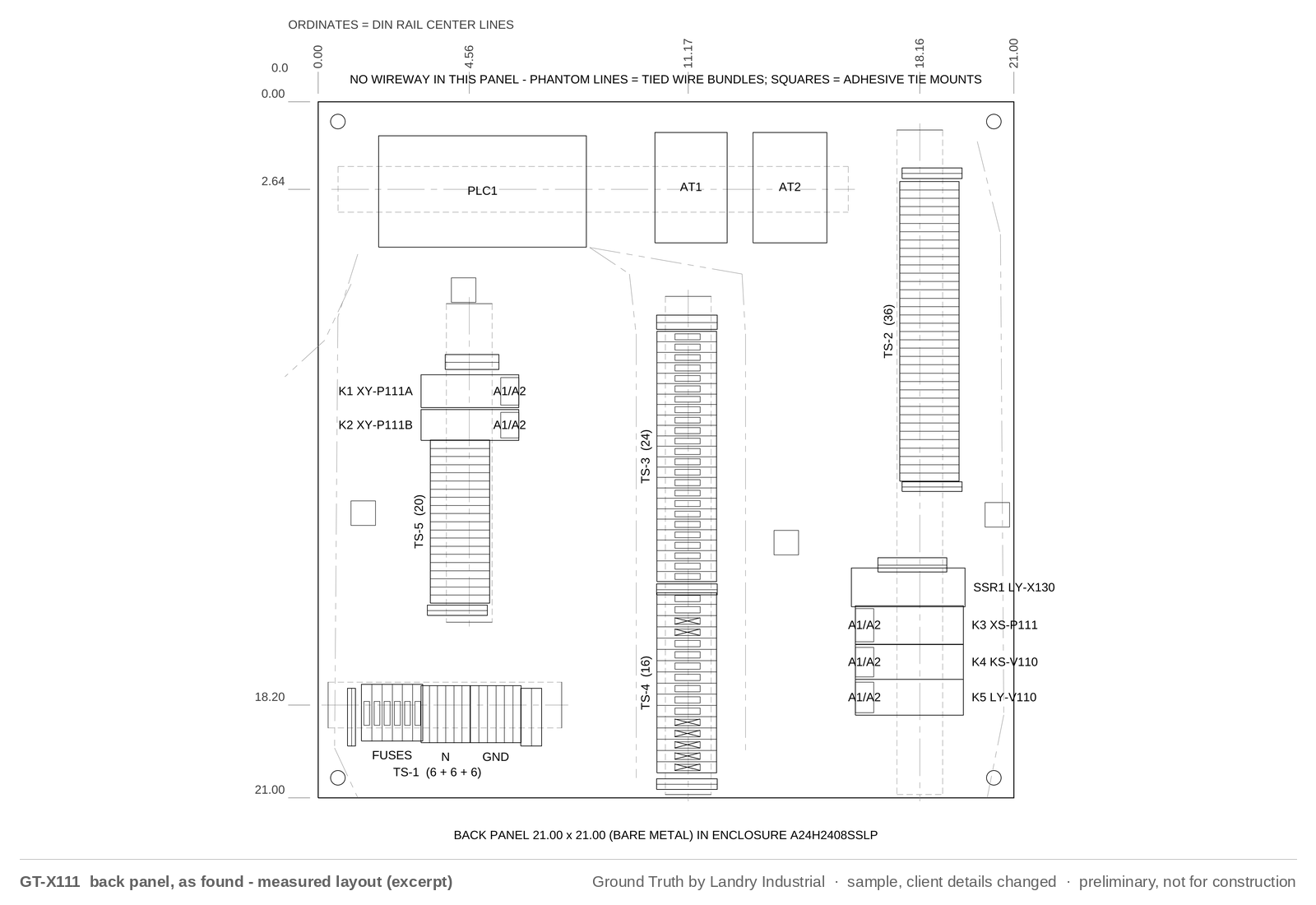
Measured back-panel layout (excerpt). The as-found back panel drawn to dimension from a photograph: rails, relays, terminal strips and wire bundles where they really are.
STEP 02 / AS-FOUND RECORD
Photos become measured as-found drawings.
Each device is identified from the photos, and the back-panel layout is measured from them to ±0.2 in. Rails, wireways, terminal strips and bundles are classified, terminals recorded and observations logged.
Sample: 4 as-found drawing sheets, a workbook and a panel model.
WHAT YOU RECEIVE
As-found drawingsDXF + PDF
As-found workbookXLSX
Panel modelHTML
WHY IT MATTERS · OWNERS
A current record of what is really in the panel, including what has been disconnected.
The real ladder, executing. The original PLC program, decoded without vendor software and drawn rung by rung, is shown in the recorded walkthrough.
STEP 03 / PROGRAM DECODED
The program backup, decoded and reconciled.
The binary project file is read directly, without vendor software, into a rung listing, address database, I/O map and cross-reference. Wire markers, the program and the door legends are then reconciled signal by signal.
Sample: 3 ladder files, 55 rungs, zero comments or descriptions. Small and fully determined: two trip latches, one timer, seven one-shots.
WHAT YOU RECEIVE
Rung listingPDF
Address databaseCSV
I/O list with confidence tagsXLSX
WHY IT MATTERS · OWNERS
An undocumented program becomes something your whole team can read.
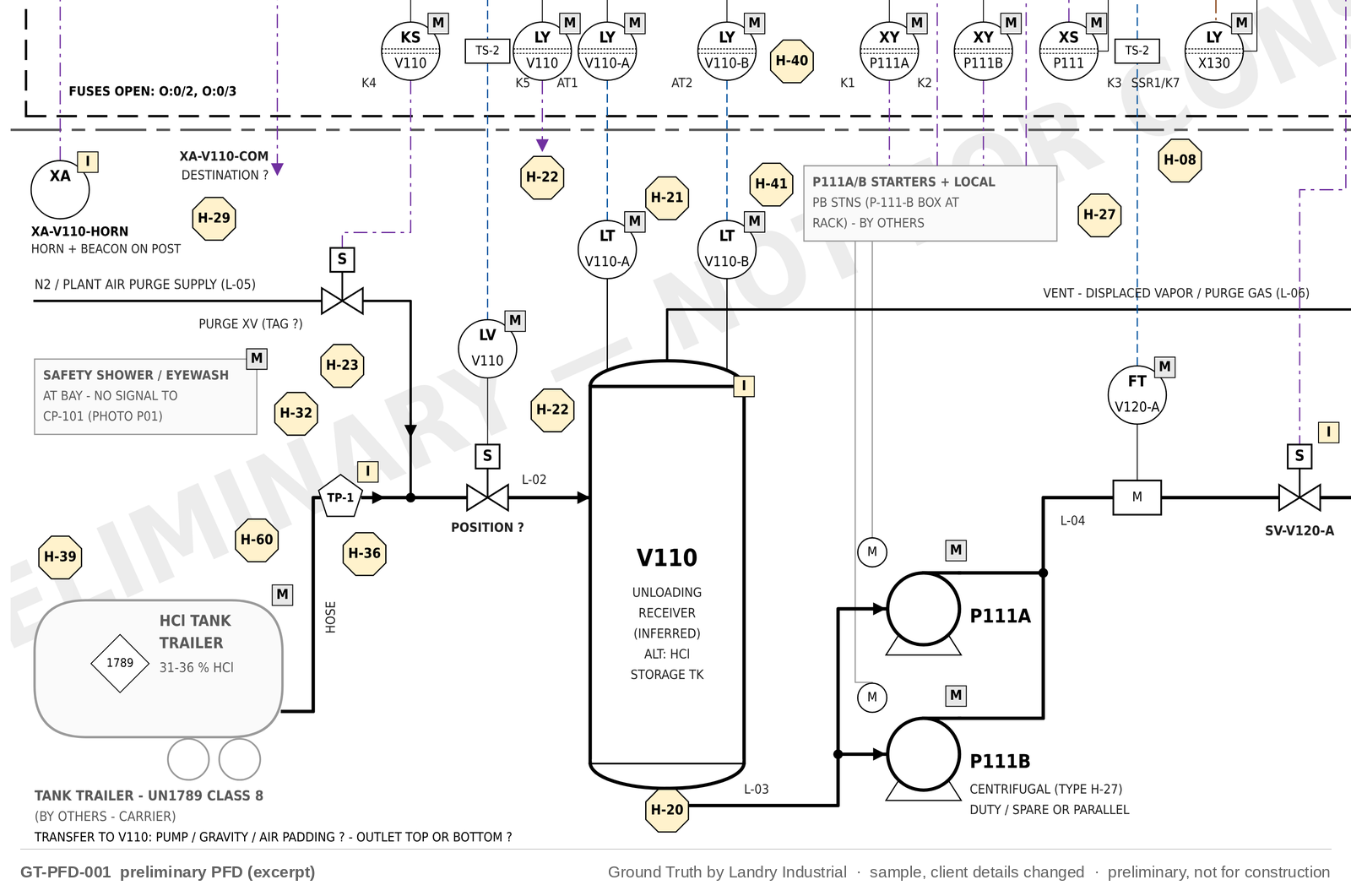
PFD excerpt: unloading bay, receiver and pumps. A readable slice of the PFD: the truck connection, the receiver, the two pumps and the panel relays that permit them, with open questions marked where they apply.
STEP 04 / PROCESS & PFD
Understand the process the logic serves.
Signals, equipment and logic come together in a preliminary process flow diagram and a written process understanding: hypotheses, a working basis and the questions to settle on site.
Sample: HCl tank-trailer unloading to receiver V110 with two transfer pumps and dual level transmitters.
WHAT YOU RECEIVE
Preliminary PFDPDF
Process understandingPDF
WHY IT MATTERS · OWNERS
Everyone reviews the same picture of the unit before decisions are made.
Narrated walk-throughs. Step-by-step walk-throughs replay real scenarios such as an E-stop, showing what the system does and why it matters.
STEP 05 / CONTROL NARRATIVE
What the system does, in plain words.
Sequences, interlocks, alarms and power-up behavior, written from the logic itself. Every statement is cited to the rung that makes it true.
Sample: the as-programmed narrative, including behavior on E-stop and power return.
WHAT YOU RECEIVE
Control narrativePDF
WHY IT MATTERS · OWNERS
Operating knowledge that no longer depends on one person’s memory.
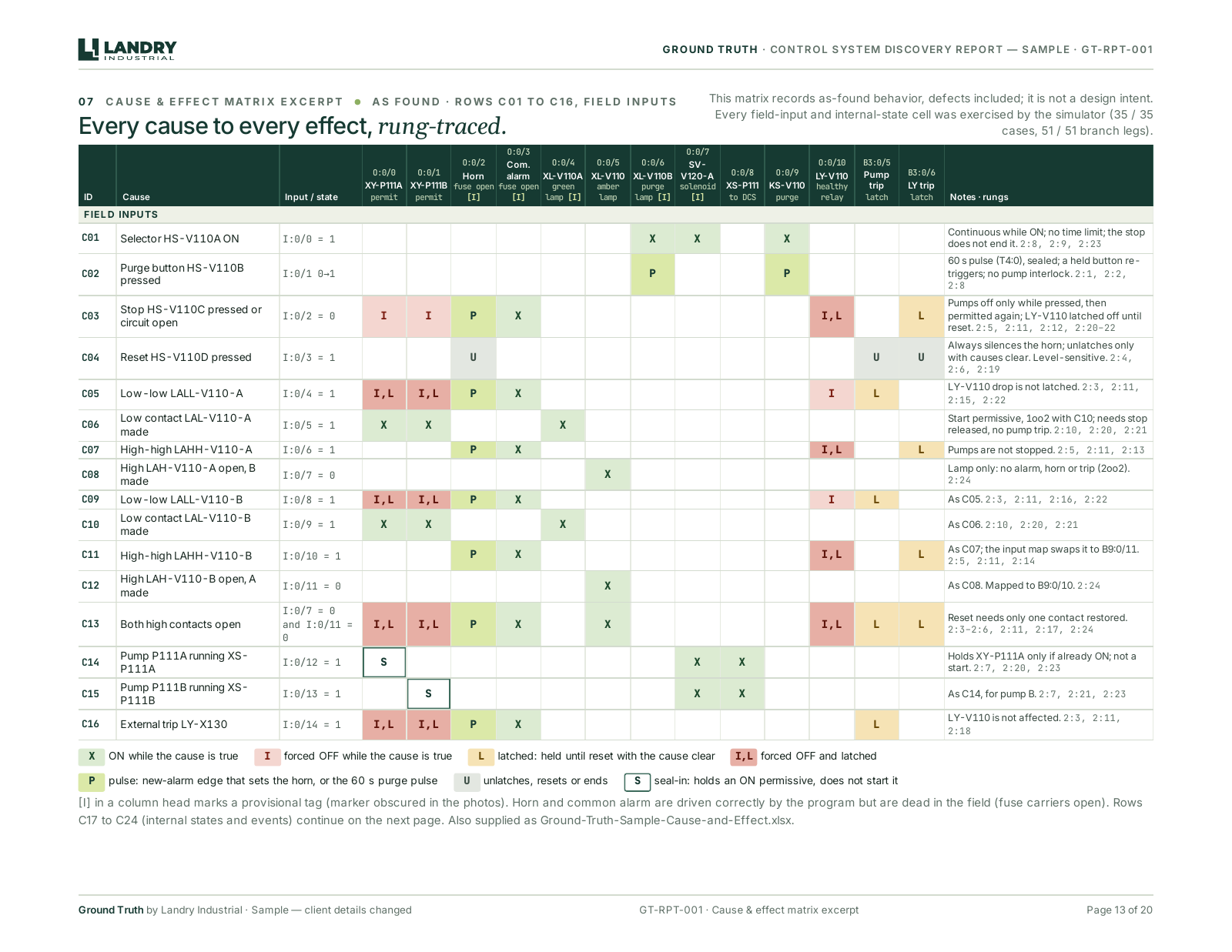
Live cause & effect. The cause & effect matrix lights up as the system runs, so anyone can see which cause produced which action.
STEP 06 / CAUSE & EFFECT
Every cause. Every effect. Traced.
A cause and effect matrix generated from the logic: each trip, permissive and alarm, its effect on every output, and the rungs responsible. Latched, pulsed and inhibited effects are coded.
Sample: every field-input and internal-state cell exercised in the simulator.
WHAT YOU RECEIVE
Cause & effect matrixXLSX + PDF
WHY IT MATTERS · OWNERS
A sound basis for PHA and LOPA revalidation: what actually happens, not what was intended.
Alarm and trip table, live. Alarms and trips are listed with their action and reset, and light up as they occur; here one shows a high-high level that does not stop the pumps.
STEP 07 / FINDINGS
Latent defects, ranked and explained.
A logic weakness review asks what the system does in the situations nobody tests: a broken wire, a held button, power returning. Each finding has a severity, the evidence and a recommended correction; most are tied to a functional test case, the rest to a FAT check or a field hold.
Sample: 14 findings. 4 severity A, 6 B, 4 C.
WHAT YOU RECEIVE
Findings registerXLSX
Logic analysisPDF
Functional test casesPDF
WHY IT MATTERS · OWNERS
A decision-ready list: what to correct now, what to take through MOC and what can wait.
The live system model. The whole unloading system on one screen: the trailer, receiver V110, pumps P111A/B and panel CP-101, all following the real PLC logic.
STEP 08 / MODEL PREVIEW
See how the model works.
The recorded sample shows the extracted logic running against a model of the plant and hardware. Walkthroughs demonstrate trips, resets and the proposed corrections on the same simulated field. The complete customer model includes a live C&E, narrated scenarios, open-question toggles and verification results.
Sample model: 13 narrated walk-throughs. The verification screenshot records 78/78 test cases and a 40,000-scan equivalence, 0 mismatches.
WHAT YOU RECEIVE
Interactive modelHTML, runs offline
Narrated walk-throughsIn the model
WHY IT MATTERS · OWNERS
Watch a latent hazard play out on screen before it happens in the plant.
What we found and what it means. What the unloading system does, how little documentation existed, the four severity-A findings (one shown live on the model), and what the package gives you before anyone changes the panel.
STEP 09 / TRAINING BY ROLE
Training at the right depth for every role.
Short narrated videos made on the model, one for each audience: management, operators, technicians, engineers and the people who will use the package. Captioned and ready for your learning system.
Sample: 5 role videos with captions.
WHAT YOU RECEIVE
Role training videosMP4 + WebVTT captions
WHY IT MATTERS · OWNERS
Everyone gets the same story at the depth their role needs.
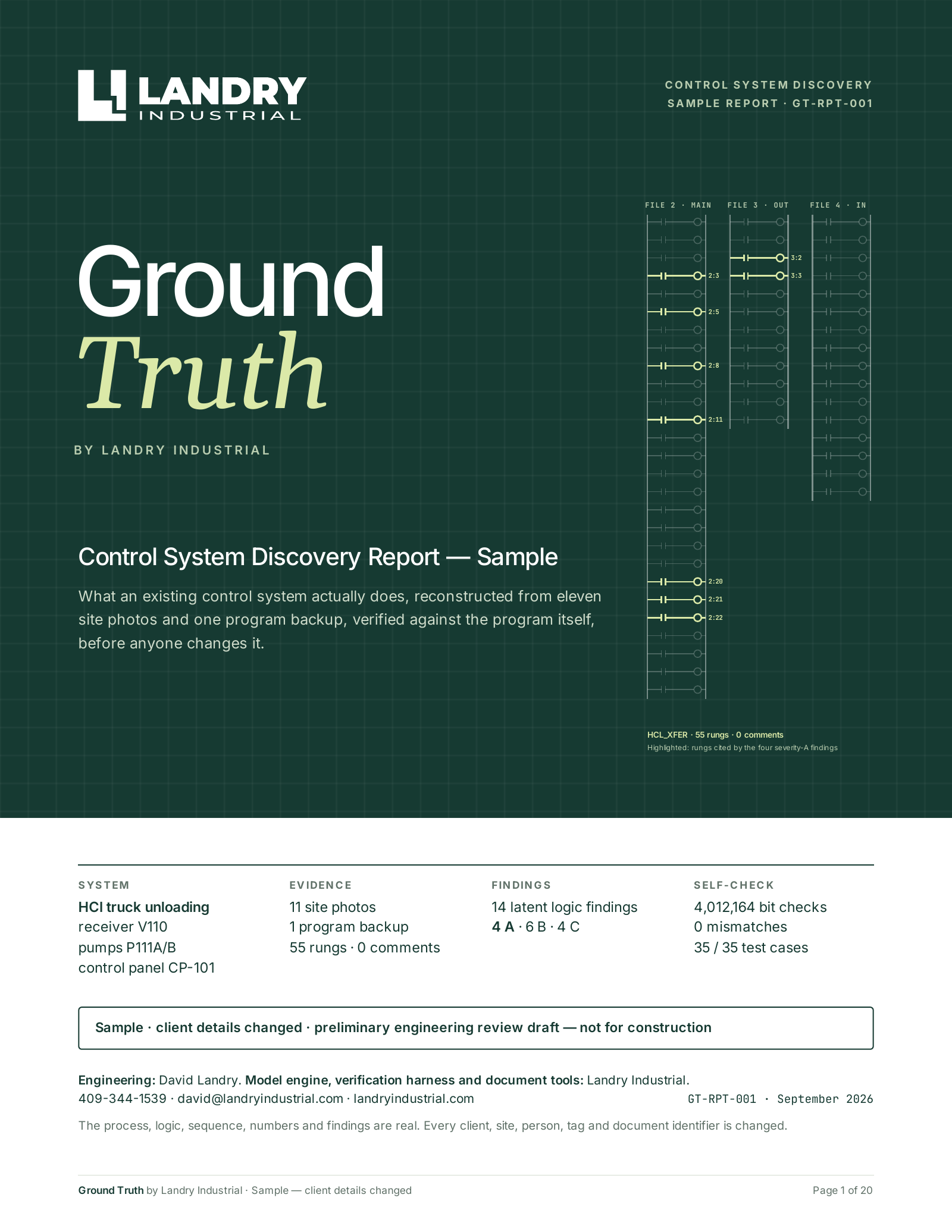
Cover (page 1 of 20). Cover: eleven photos and one program backup, 14 findings, 4,012,164 bit checks with 0 mismatches.
STEP 10 / PACKAGE HANDOFF
A package that fits your systems.
Holds and RFI register, a field-verification checklist, independent cross-check rounds, and package assembly with an index, spelling check and identifier scan. Delivered on your numbering and title blocks, into your document control.
Sample: holds register and field-walk checklist issued with the package.
WHAT YOU RECEIVE
Holds & RFI registerXLSX
Field-verification checklistPDF
Discovery reportPDF
WHY IT MATTERS · OWNERS
A defined deliverable you own, ready for the next decision.
01 / 10
THE MODEL, DEMONSTRATED
See the logic in action.
Watch the recorded walkthroughs to see how the model exposes trips, resets and open questions. Arrange a guided demonstration to explore the model with us.
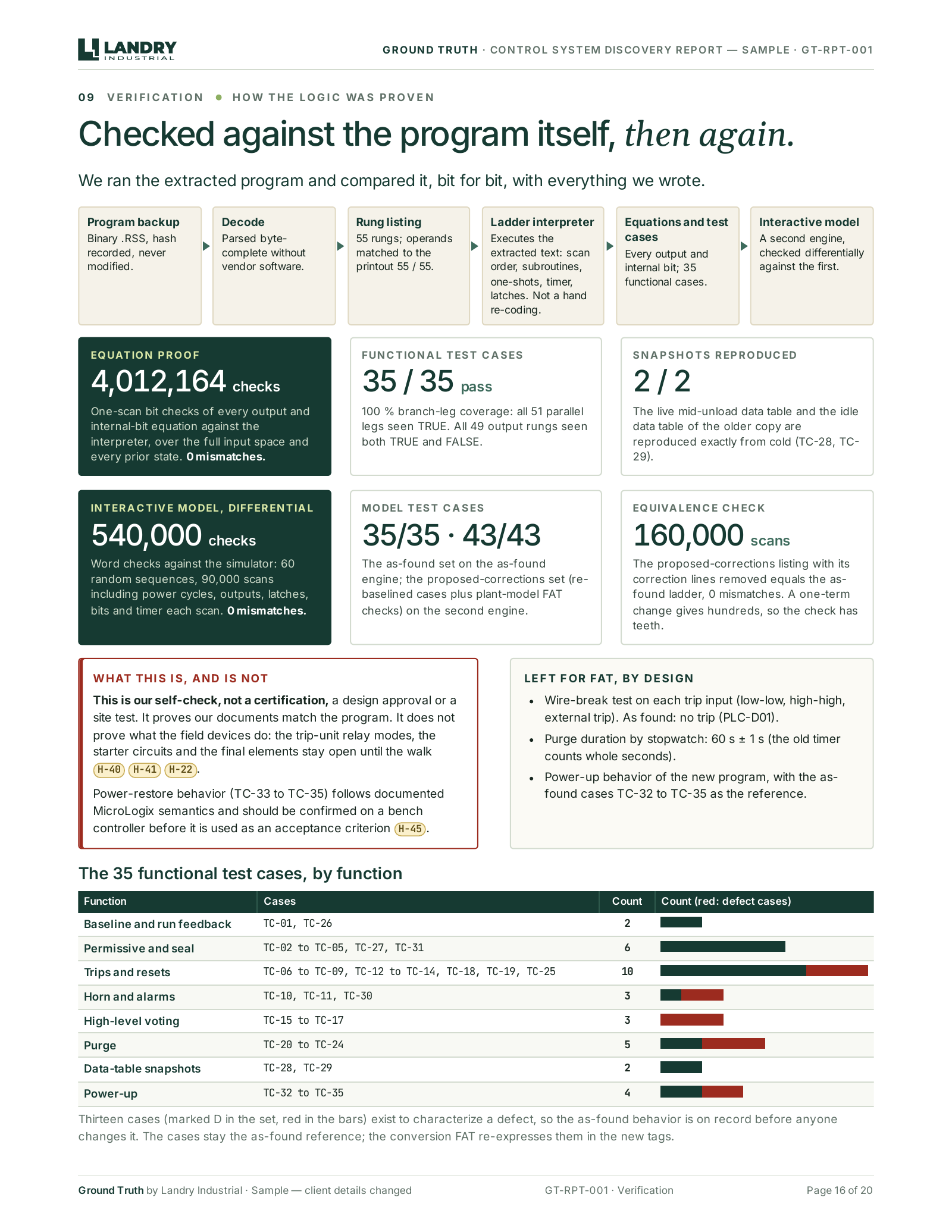
4,012,164one-scan bit checks against an independent ladder interpreter · 0 mismatches
540,000word checks, interactive model against the simulator · 0 mismatches
35/35as-found functional test cases pass · 100 % branch-leg coverage
43/43test cases for the proposed corrections pass
160,000scan equivalence check at build · the sample model’s self-check runs 40,000
This proves our documents match the program. It does not prove what the field devices do — those are the open questions for the field walk.
The customer model includes 13 narrated scenario walk-throughs, a live cause and effect view and “open question” toggles. Interactive models and native files are provided through scoped customer engagements.
TRAINING FOR EVERY ROLE
The same system. Explained five ways.
Short narrated videos made on the sample model, captioned and ready for a learning management system. Choose the one that matches your role. Swipe for all five →
For management · 1:27
What we found and what it means
What the unloading system does, how little documentation existed, the four severity-A findings (one shown live on the model), and what the package gives you before anyone changes the panel.
For owners, plant managers and engineering managers.
The normal as-found sequence on the CP-101 door buttons and lamps, from hook-up to purge, with the silent horn, the extra reset and the proposed high-high response.
CP-101 I/O, relays and open fuse carriers, the SSR for LY-X130, the I/O and forces view, an open wire on an energize-to-trip input that gives no trip, and the event log.
The extracted ladder executing with live power flow, the live cause and effect, two findings on their rungs, the proposed corrections and the verification shown on the page.
A guided tour of the offline model (modes, inspector, tabs, walk-throughs, open questions, faults, verification) and where every other deliverable lives.
In a Full Ground Truth engagement the videos are recorded on the model of your own system, one for each role that needs it. MP4 with WebVTT captions, ready for your learning management system.
Select a preview to inspect it at full size. Sample · client details changed · preliminary engineering review draft — not for construction.
Engineering: David Landry. Model engine, verification harness and document tools: Landry Industrial.
Ground Truth · David Landry · Landry Industrial
Optional follow-ons: a redesign basis (platform selection, panel drawings, bill of materials and a standards compliance review), program conversion and FAT procedures.
SAMPLE DRAWINGS & MODEL PREVIEWS
Select an image to inspect a sample drawing or panel model preview. Swipe for more →
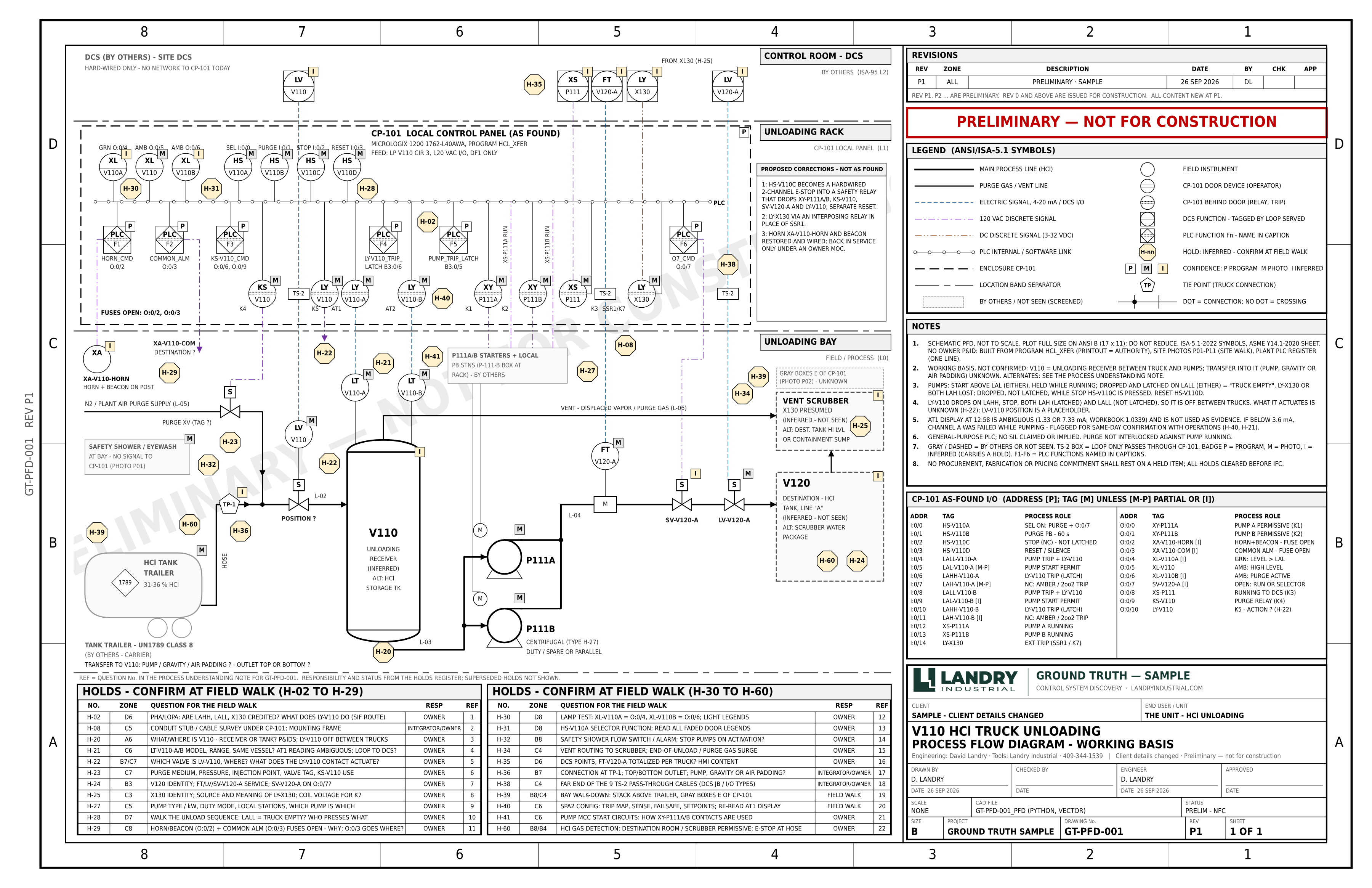
The process as we understood it from the program backup and site photos, with every open question flagged as a numbered hold before anyone walks the site.
How it was made
ISA-5.1 working-basis PFD built without an owner P&ID: addresses from the extracted program [P], tags from wire markers [M], inferences [I] carry holds H-02 to H-60, with the CP-101 as-found I/O table and legend on the sheet.
A readable slice of the PFD: the truck connection, the receiver, the two pumps and the panel relays that permit them, with open questions marked where they apply.
How it was made
LT-V110-A/B, LV-V110 and the purge valve tie back to CP-101; K1/K2 (XY-P111A/B) are the pump permissives; octagons are holds and the P / M / I badges give the evidence confidence of each tag.
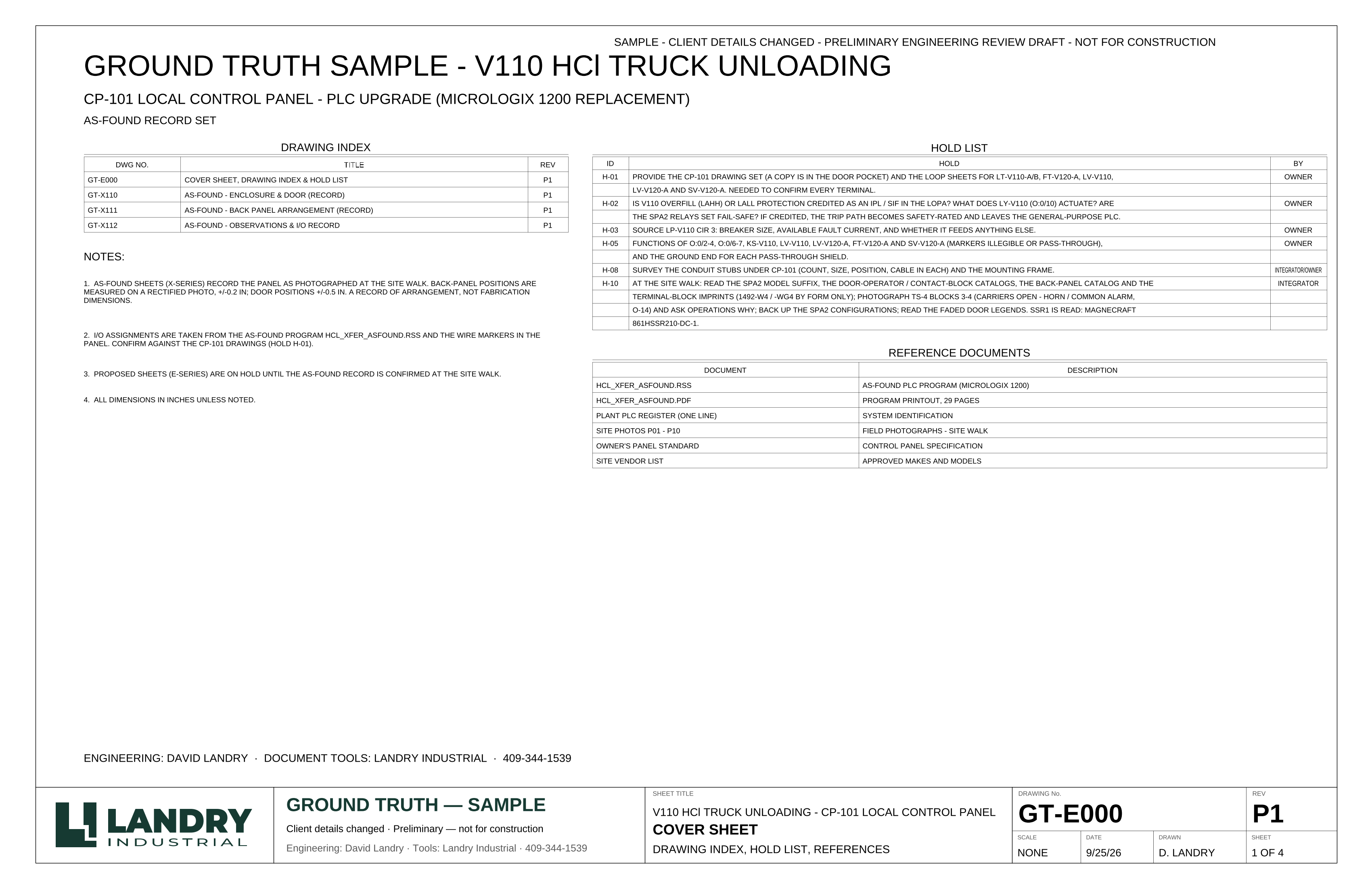
The front sheet lists what was drawn and, just as important, what still has to be confirmed and by whom.
How it was made
Index of the X-series as-found sheets, the as-found hold list (H-01 to H-10) with responsibility (owner or integrator), and the reference documents: program backup and printout, the plant PLC register (one line), site photos P01 to P10, the owner's panel standard and the site vendor list.
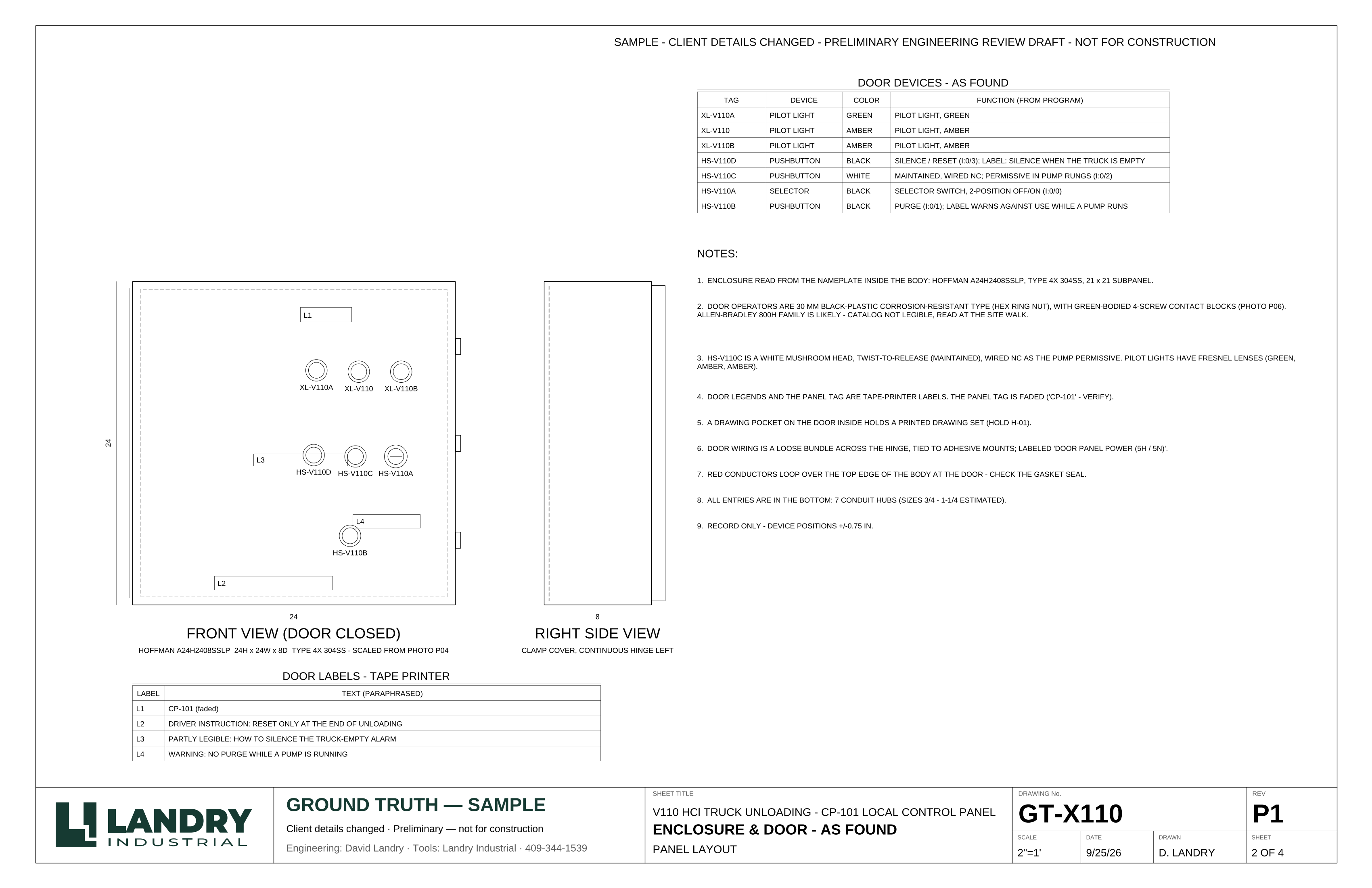
The door as the operators see it: every light, button and label recorded, including the faded ones.
How it was made
Front and right-side views at 2"=1' scaled from a photo (door positions +/-0.5 in); door device schedule with the function each device has in the program, tape-printer labels (paraphrased), Type 4X 304SS enclosure identified from its nameplate.
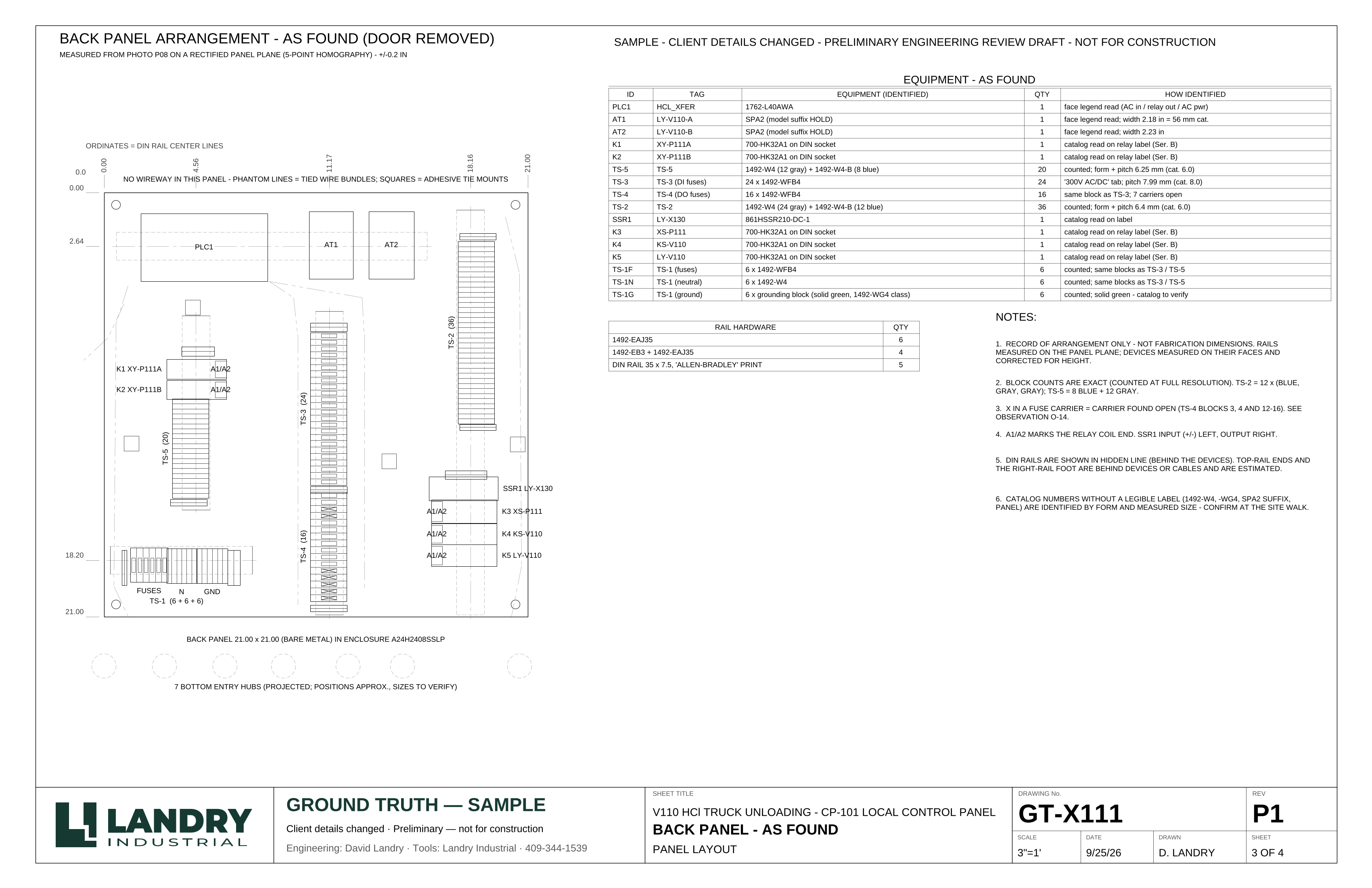
A measured drawing of the inside of the panel produced from one photograph, so the upgrade can be planned before anyone opens the door.
How it was made
Rectified-photo measurement (5-point homography, +/-0.2 in) at 3"=1': DIN-rail center-line ordinates, device callouts, terminal strips with block counts and open fuse carriers marked, equipment table stating how each part was identified.
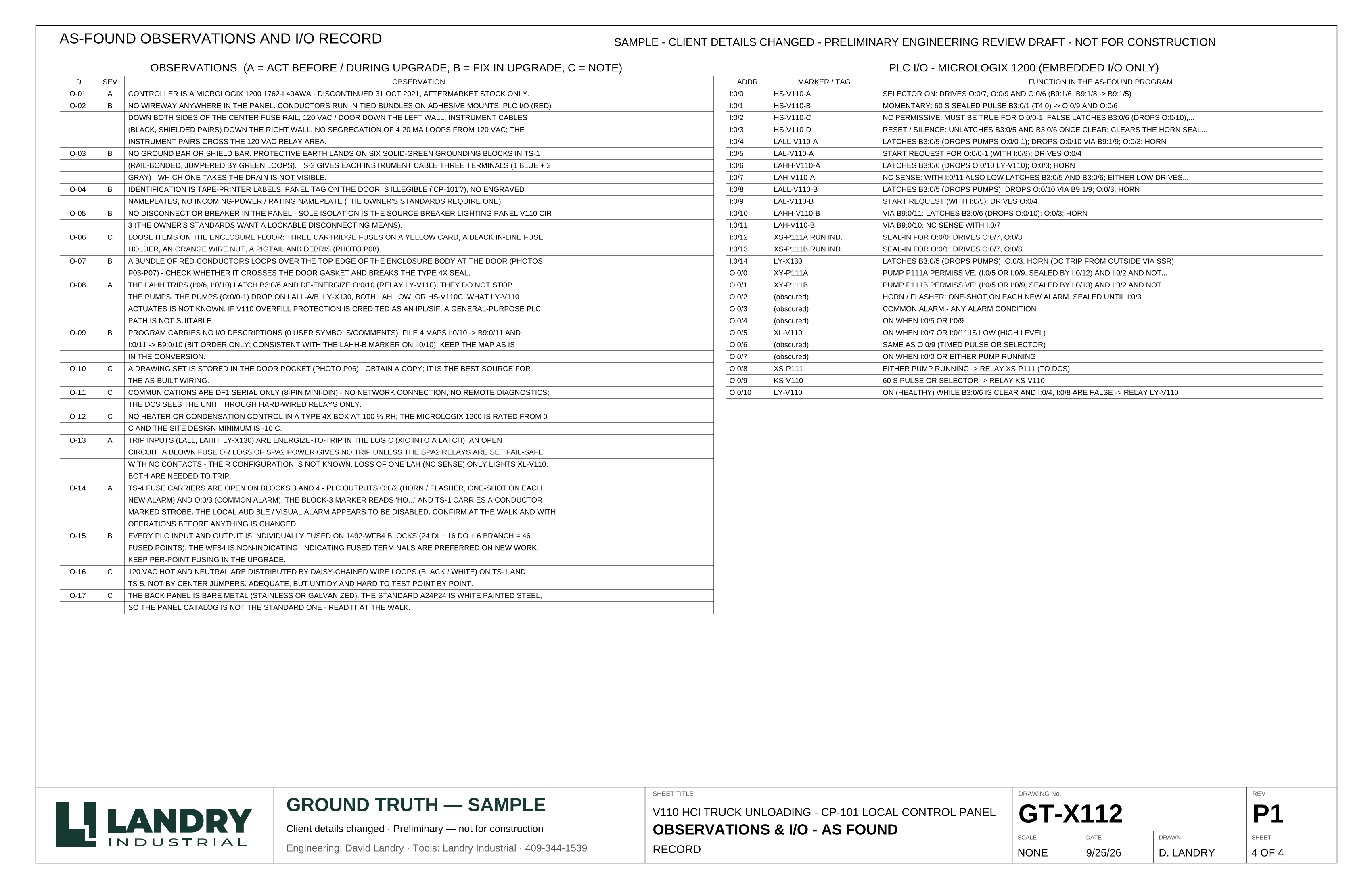
Seventeen field observations graded by when they must be acted on, next to what every PLC input and output actually does in the running program.
How it was made
Observations O-01 to O-17 graded A (act before or during the upgrade), B (fix in the upgrade) or C (note), such as energize-to-trip inputs, open horn fuse carriers and no disconnect; MicroLogix 1200 embedded I/O with wire-marker tag against the function in the as-found ladder.
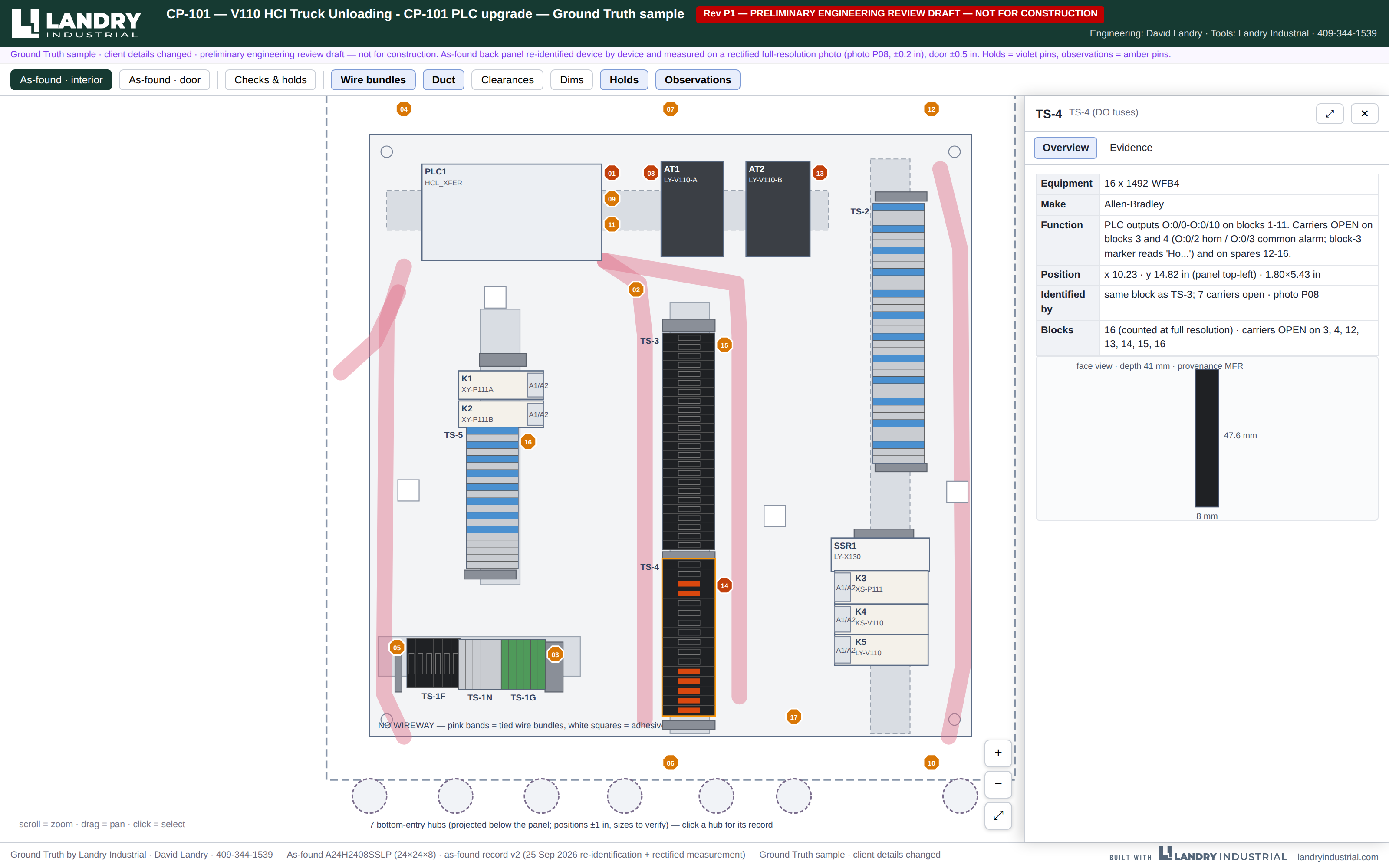
The as-found back panel drawn to dimension from a photograph: rails, relays, terminal strips and wire bundles where they really are.
How it was made
Ordinates are DIN-rail center lines on the 21.00 x 21.00 in back panel, measured on a rectified photo to +/-0.2 in; the TS-4 fuse carriers marked X were found open (horn and common alarm outputs).
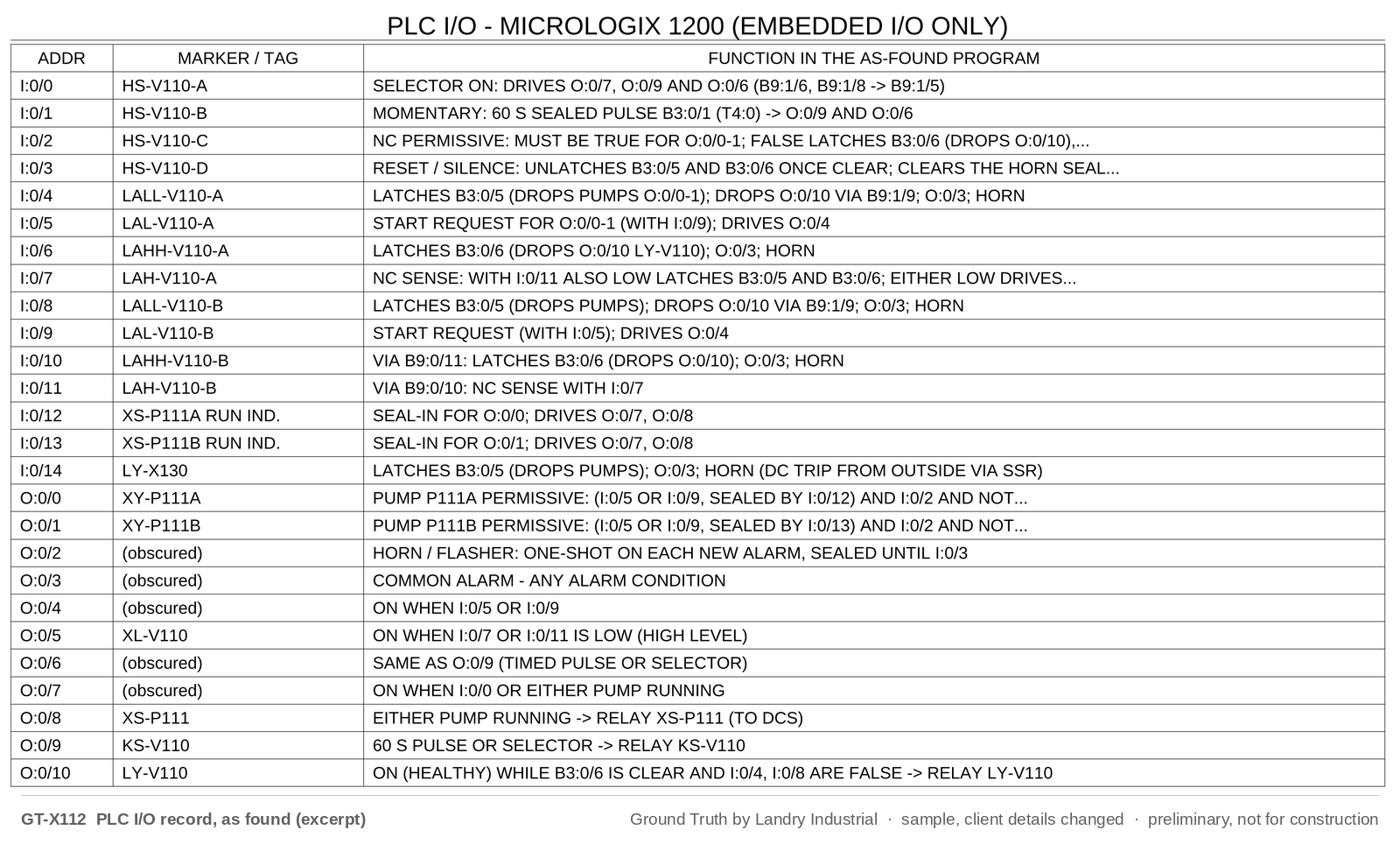
Every wire on the controller traced to what it does in the program, so nothing is lost when the controller is replaced.
How it was made
MicroLogix 1200 embedded I/O I:0/0 to O:0/10: wire-marker tag against the function decoded from the as-found ladder (latches, seal-ins, permissives); markers that could not be read are listed as obscured, not guessed.
The same panel as a clickable model: select any part to see what it is, where it is and how it was identified.
How it was made
Offline HTML model built from the as-found record; here TS-4 is selected, showing 16 x 1492-WFB4, the outputs it carries, its measured position, the identification basis and the open carriers, with holds and observations pinned on the layout (site photos are withheld in the public sample).
The package arrives on your standards and flows into the systems you already run: document control, change management, hazard studies, maintenance and training.
8 ways it fits: standards, EDMS, MOC, PHA, CMMS, LMS, offline, data
STANDARDS
Your numbering and title blocks
Drawings and documents issued on your numbering, title blocks and CAD standards.
DOCUMENT CONTROL
Into your EDMS
Delivered into SharePoint or your document control system, with an index and revision status.
CHANGE
Findings become MOC items
Each finding has a severity, the evidence and a recommended correction; most are tied to a functional test case, the rest to a FAT check or a field hold.
SAFETY STUDIES
Feeds PHA and LOPA
The as-found C&E and findings support hazard study revalidation with the behavior that actually runs.
MAINTENANCE
Device list to your CMMS
The as-found device list feeds spares, lifecycle and obsolescence planning.
TRAINING
Videos to your LMS
MP4 with captions, ready to load into your learning management system.
ACCESS
A model that runs offline
One HTML file in any browser. No install, no vendor license, no network calls.
DATA HANDLING
Your data stays controlled
NDA first. Work can stay on your machines. Nothing is published without your written approval.
PLATFORMS
RSLogix 500 · MicroLogix · SLC 500PROVENProven on this sample.
Studio 5000 · L5XNEXTNext adapter, building on LogicLens →
DeltaV · FHXNEXTNext adapter, building on FHX Studio →
Other platformsON REQUESTDiscuss your platform and export format.
RSLogix, Studio 5000, MicroLogix and SLC are trademarks of Rockwell Automation. DeltaV is a trademark of Emerson. No affiliation or endorsement is implied.
HOW AN ENGAGEMENT WORKS
A defined first step. A clear path forward.
Every engagement is scoped and priced in a written proposal before work begins. Deliverables, data handling, access and ownership are agreed there too.
01 / ONE SYSTEM
Discovery Snapshot
One system. The essential understanding.
↳Discovery report
↳Control narrative
↳Cause & effect matrix
↳Findings register
02 / ONE SYSTEM, COMPLETE
Full Ground Truth
The Snapshot, plus everything your team needs to use it.
↳As-found drawings
↳Interactive model
↳Role training videos
↳Holds register & field checklist
03 / MANY SYSTEMS
Fleet
Many systems, one method and one register.
↳A consistent package for each system
↳A cross-site findings view
↳Links to the PLC/HMI fleet-management system we are developing
01
Walk & collect
NDA first. We gather photos, the program backup and whatever documents exist, and agree the confidentiality boundary.
02
Decode
Program, as-found record and signals, each with its source and confidence.
03
Model
Narrative, C&E, findings and the live model of the actual logic.
04
Review with your team
Walk the findings on the model with operations and engineering, and resolve the holds.
05
Hand over
The package on your numbering, into your document control, with training videos for your LMS.